


Manufacturing projects carry some of the highest risk profiles in any sector. Raw material volatility, global supply chain interruptions, tightening compliance requirements, and accelerating cost pressures mean that manufacturers who treat risk management as a reactive checklist will consistently fall short of delivery timelines and budgets.
For PMO leaders and transformation executives, the question is not whether manufacturing risks exist. It is whether your organisation has the right processes, visibility, and tools to identify, assess, and act on them before they become costly failures.
This guide covers the key elements of managing risks in manufacturing projects, from building a structured risk-management plan to prioritising risks under budget pressure, and shows how integrated project portfolio management software gives PMO teams the control they need across the full portfolio.
Key takeaways
Manufacturing risks span supply chain, safety, compliance, financial, and operational dimensions, each demanding specific mitigation strategies.
A proactive risk-management plan consistently beats reactive responses on both cost efficiency and project quality.
Risk assessment should run continuously throughout the project lifecycle, not just at kick-off.
Prioritising risks by impact and probability helps PMO leaders allocate resources where they matter most.
Integrated PPM software gives manufacturers real-time visibility into project risk across the entire portfolio.
What makes manufacturing project uniquely risky
Manufacturing operations sit at the intersection of physical assets, complex global supply chains, skilled labour, and strict regulatory requirements. Unlike software projects, a delay in a manufacturing project often has physical consequences, such as idle machinery, production line shutdowns, or safety incidents that trigger insurance claims and regulatory scrutiny.
Manufacturing projects also tend to involve large capital outlays, long lead times, and multiple contractors working in parallel. A single quality failure or schedule slip can cascade through the programme, driving up loss exposure and eroding margins. Being prepared and proactive before those failures crystallise is the only reliable way to protect project outcomes.
Supply chain disruptions and geographical sourcing challenges
Supply chain interruptions rank among the highest risks facing manufacturers across any sector. Single-source supplier dependencies, political instability, and logistics failures can stall entire production lines. Manufacturers who have not reviewed their geographical sourcing strategies recently are operating with an outdated risk profile.
A resilient risk-management plan includes clear protocols for supplier contingency, defined lead-time buffers, and a deliberate strategy to diversify their suppliers across multiple regions. This is not just insurance against worst-case scenarios; it is how adaptable supply chains absorb disruption without triggering project delays.
Cost pressures, economic slowdown, and budget volatility
Cost pressures hit manufacturing projects from multiple directions: raw material inflation, labour shortages, energy prices, and equipment lead-time extensions. During periods of economic slowdown, capital budgets tighten while project scopes often remain fixed, a tension that demands sharper prioritisation and more rigorous cost risk tracking.
PMO leaders who build risk assessment into standard project governance, rather than treating it as a periodic finance exercise, maintain better control over loss exposure and can escalate issues before they become write-offs. Organisations that treat cost risk as a live, monitored data point consistently outperform those that treat it as an annual review.
Four components every executive team should consider in a risk-management program
A credible risk-management program in manufacturing is not a spreadsheet. There are four components that every executive team should consider when building or evaluating their approach:
Risk identification: A structured process that captures manufacturing risks at the project, programme, and portfolio levels, not just at kick-off, but throughout the lifecycle. Projects evolve; risk registers that do not evolve with them become liabilities.
Risk assessment: Scoring risks by probability and impact separates high-priority issues from background noise. This gives PMO teams a defensible basis for resource allocation and escalation decisions.
Risk mitigation: Defined response strategies for the highest risks, whether that is activating a secondary supplier, adjusting project timelines, increasing inspection frequency on critical components, or adjusting contractor scope.
Risk monitoring and reporting: Ongoing visibility into risk status, with clear escalation paths and regular review cadences built into project governance. Without structured reporting, risks move off the register and reappear as project failures.
Organisations that implement all four components consistently report fewer project delays, lower insurance costs on manufacturing projects, and stronger compliance records. Read more about the hardest aspects of maturity and how to improve them.
How to priorities rick across manufacturing operations
Not all risks carry equal weight. A safety risk on a production floor demands immediate attention; a low-probability supply chain disruption for a non-critical component resource on the register. The skill in manufacturing risk management lies in developing a repeatable method to prioritise risks, and then acting on that prioritisation with speed and discipline.
Balancing safety investments with schedule and budget
Balancing safety investments against project timelines is one of the harder judgment calls in manufacturing project management. Safety failures are not just a human cost; they trigger regulatory scrutiny, insurance claims, production shutdowns, and reputational loss. Yet over-investing in controls for low-probability scenarios diverts resource from higher-impact risks elsewhere in the project.
A structured risk assessment framework helps PMO leaders make that trade-off with data rather than instinct. Cora's PPM platforms surfaces risk scores across the portfolio, giving executives a consolidated view of where safety and project risks intersect and where mitigation spend delivers the most value.
Manufacturing safety, compliance, and contractor risk
Manufacturing safety requirements vary by sector, geography, and project type. Contractors working on a capital expansion bring their own risk profiles: different safety cultures, varying compliance maturity, and gaps in quality management. Managing these third-party risks requires clear contractual requirements, defined inspection processes, and real-time visibility into contractor performance.
PMO leaders who integrate contractor risk into their broader project management process, rather than treating it as a procurement handoff, catch manufacturing safety issues before they escalate into failures with real operational consequences.
Building an adaptable risk-management plan
Static risk registers fail. Manufacturing operations change constantly: new suppliers, revised project scopes, emerging regulations, and shifting market conditions all alter the risk landscape. Being prepared and proactive means building risk-management programs that update as the project evolves, not a document filed after the kick-off and revisited at close-out.
Diversifying suppliers too manage potential threats
To effectively diversify their suppliers and manage potential threats, manufacturers need visibility into current supplier dependencies, including which regions, tiers, and categories carry concentration risk. Geographical sourcing data, combined with supplier performance history, gives PMO teams the intelligence to make proactive sourcing decisions, rather than scrambling after a disruption.
Manufacturers who align their supply chain risk strategies with their portfolio risk registers create a direct line of sight between supplier vulnerabilities and potential outcomes. This spot is where slow-recovery scenarios become visible early enough to act on.
Resource management and avoiding project delays
Resource constraints are among the most common triggers for project delays in manufacturing. When skilled labour or specialised equipment is shared across multiple projects, a slip on one programme creates a cascading resource conflict across the portfolio. Left unmanaged, those conflicts compound, turning a two-week delay into a two-month schedule failure.
An integrated PPM platform with real-time resource management capabilities lets PMO leaders spot those conflicts early and replan before they crystallise. Cora links risk events directly to capacity data, giving operations teams the full picture of how a supply chain disruption or manufacturing safety event will ripple through the programme schedule.
How Cora's PPM platforms supports surface factoring risk management
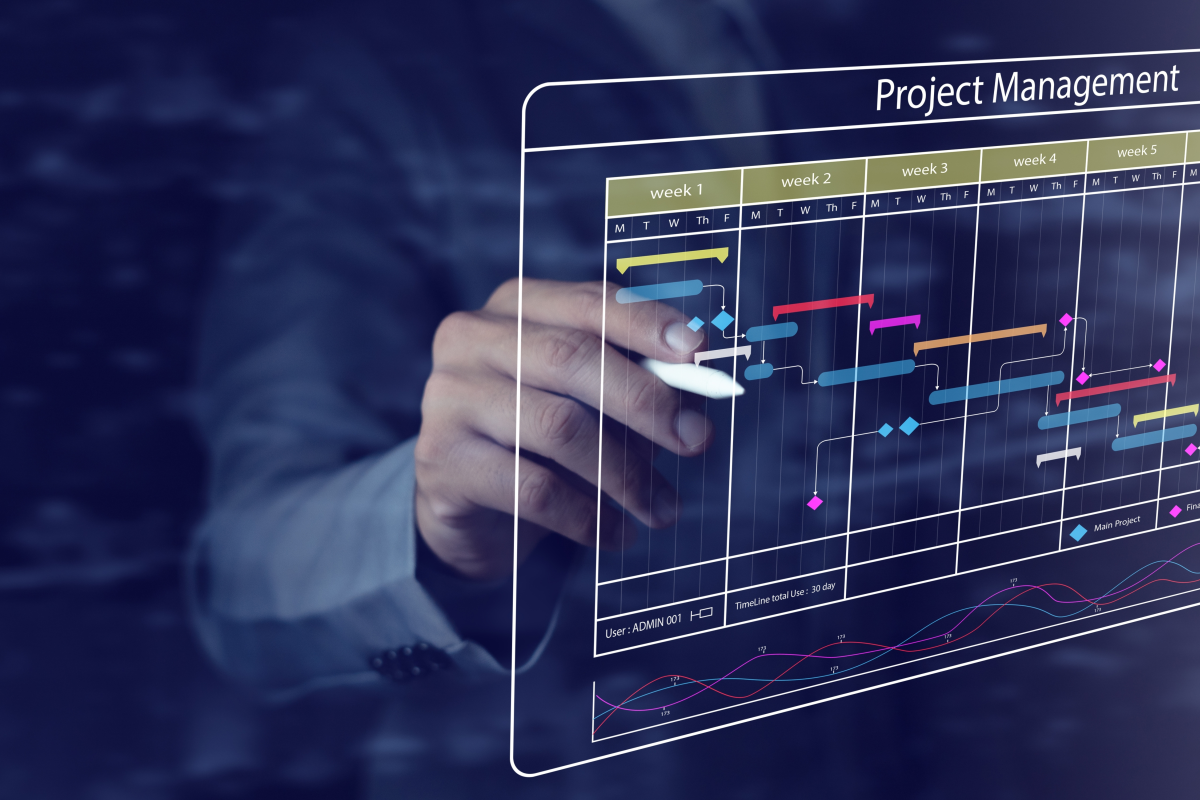
Cora provides project portfolio management software built for organisations running complex manufacturing projects at scale. The platform gives PMO teams a structured, real-time view of risk across all projects and programmes, replacing disconnected spreadsheets and siloed risk processes with a single source of truth.
Key capabilities for manufacturing risk management include:
Centralised risk register: Captures manufacturing risks at the project, programme, and portfolio levels, accessible in one place, updated in real time.
Executive dashboards: Surfaces the highest-impact risks for leadership review without requiring manual data gathering from project managers.
Automated reporting: Keeps stakeholders informed across the risk-management lifecycle, reducing the administrative burden on operations teams.
Resource management integration: Links risk events to capacity constraints, giving PMO leaders early warning of resource-driven project delays.
Compliance tracking: Built into project workflows, so manufacturing safety and regulatory requirements stay visible throughout the project, not just at audit time.
For manufacturers dealing with large capital projects, multi-tier supply chains, and regulatory complexity, Cora replaces fragmented tools with a platform built for the scale and rigour their manufacturing operations demand.
Take control of manufacturing risk with Cora
Managing risks in manufacturing projects gets harder as project complexity grows, with more suppliers, more regulatory requirements, and more concurrent programmes competing for the same resources. Ad hoc risk management cannot keep pace with that complexity, and the cost of getting it wrong shows up fast: in project delays, insurance claims, compliance failures, and eroded margins.
Cora's PPM platform gives PMO leaders the visibility, process discipline, and real-time data they need to identify and manage potential threats before they become project failures. Whether you are running capital projects, production line expansions, or multi-site manufacturing operations, Cora brings your risk-management programs into a single, integrated platform.
:format(webp))
:format(webp))
:format(webp))
:format(webp))
:format(webp))
:format(webp))
:format(webp))

:format(webp))