Most portfolio risk management still runs on periodic reviews and static risk registers. By the time a risk appears on a report, it has often already started eroding value. The latest research from Gartner® How to Use AI to Improve Portfolio Risk Management and Protect Value sets out how AI changes that. It shows how organizations can move from logging risks to predicting them, from project-level visibility to portfolio-wide insight, and from reactive fixes to confident investment decisions.
In this blog, we summarize the report’s six practical steps, its key recommendations and the measures that show whether your approach is actually working.
Three key recommendations
Sense risk continuously across portfolios. Combine internal delivery indicators with external signals such as geopolitical and supply chain disruption.
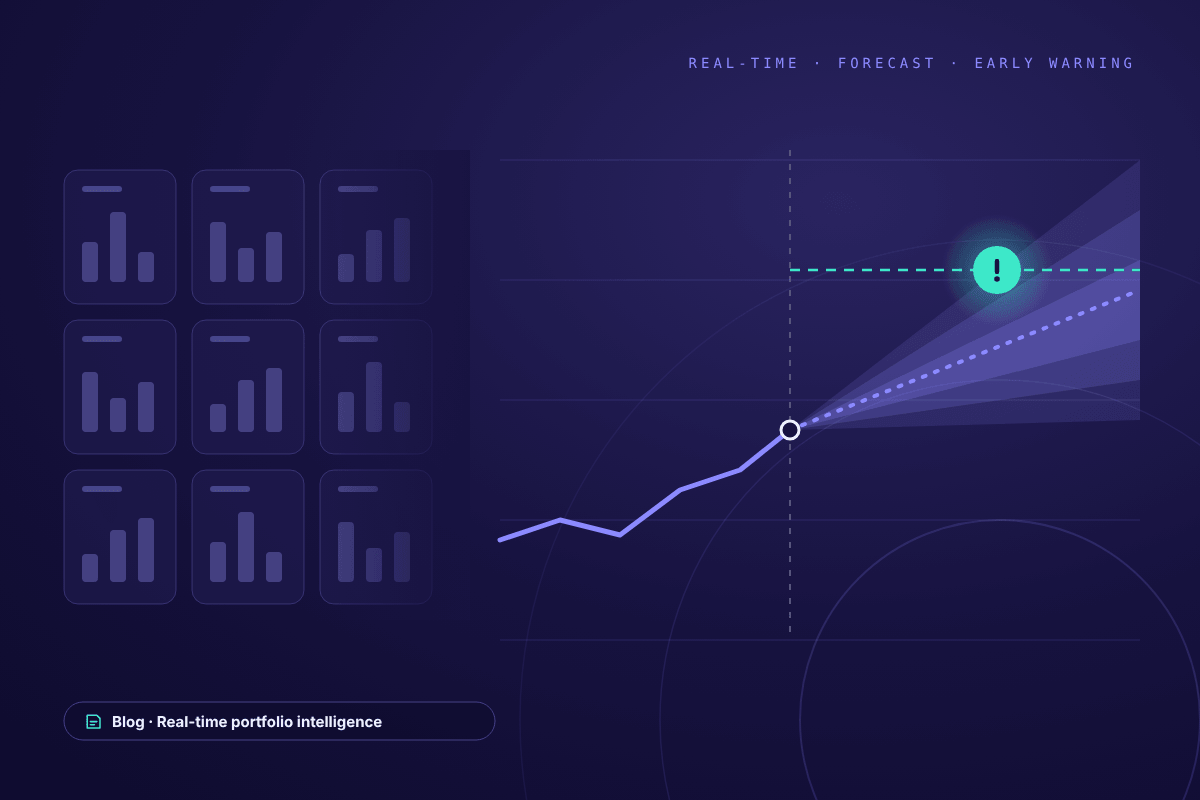
Replace single-point estimates with probabilistic forecasts. Show confidence-based outcome ranges, giving leaders a realistic view of schedule, cost and benefits.
Embed AI-driven risk insights directly into portfolio reviews. Prioritize initiatives by risk-adjusted value and track their impact on strategic objectives.
“AI-enabled risk management is not a process improvement initiative; it is a strategic portfolio capability.” — Gartner
Six steps to AI-enabled portfolio risk management
1. Build a portfolio risk intelligence foundation
Most organizations already hold the data needed for better risk management. The problem is it sits in disconnected project, financial, resource and operational systems. Gartner’s first step is to bring it together.
Start by identifying leading indicators of risk, such as schedule variance, resource shortages, dependency delays and budget changes. Inventory the data sources that inform risk assessments, then integrate them with external sources covering regulation, markets, geopolitics and supply chains. That takes collaboration between IT, data and analytics teams and the PMO, plus clear data ownership and quality standards. The aim isn’t perfection, just enough visibility for portfolio-level decisions.
2. Implement continuous risk sensing with AI
Periodic reporting cycles leave gaps. Risks can emerge and escalate between reviews unnoticed. AI closes those gaps by analyzing changing conditions continuously.
Organizations should ingest structured data, such as schedules, budgets and resource utilization, alongside unstructured sources like risk narratives and meeting notes, where natural language processing can surface recurring concerns and shifts in sentiment. Automated data pipelines keep information fresh without manual reporting. Machine learning, anomaly detection and pattern recognition then identify emerging risks across internal and external data, triggering alerts when leading indicators point to adverse outcomes. The result is ongoing situational awareness rather than retrospective reporting.
“Organizations that deploy AI as a reporting tool will realize limited benefits; organizations that redesign portfolio decision making around AI-driven risk intelligence will gain a sustained decision advantage.” — Gartner
3. Introduce probabilistic forecasting and scenario analysis
Portfolio decisions often rest on single-point assumptions that understate uncertainty. AI supports more realistic planning through probabilistic forecasting, estimating a range of possible outcomes and how likely each is. Instead of forecasting that an initiative will finish in September, leaders can see the likelihood of completion within different timeframes, given current risks.
Per our understanding, Gartner recommends modeling multiple delivery scenarios using simulation techniques such as Monte Carlo, estimating confidence levels for schedule, cost and benefit targets, and assessing how interconnected risks spread across initiatives. The result is a clearer picture of portfolio exposure and value at risk, supporting better decisions under uncertainty.
4. Embed AI-driven insights into portfolio decisions
Risk intelligence only creates value when it shapes decisions. Gartner, as per us, makes it clear that AI should influence, not replace, human judgment, and that it must not become a checkbox compliance exercise. In practice, that means bringing AI-generated risk insights directly into portfolio reviews and investment decisions.
Initiatives should be evaluated on risk-adjusted value rather than business cases alone, so leaders can see which investments are genuinely likely to deliver. Scenario recommendations help teams compare response options and intervention strategies. Transparency, governance and oversight of AI recommendations keep accountability with people. The payoff is faster, better-informed decisions that leaders can stand behind.
“The value of AI-enabled risk management is realized only when risk intelligence influences — not replaces — decisions.” — Gartner
5. Align risk management to portfolio value realization
Risk management should protect business outcomes, not just project delivery performance. Our takeaway is that Gartner advises mapping portfolio risks to strategic objectives, benefits and enterprise KPIs, so every risk is understood in terms of the value it threatens.
Value at risk should be measured at initiative, portfolio and enterprise levels, and risk responses prioritized by their potential impact on expected business outcomes. Portfolio risk intelligence should then inform how investment is allocated and reprioritized. Organizations that treat AI-enabled risk management as a portfolio capability, spanning data, monitoring, forecasting, governance and value realization, will be better placed to anticipate uncertainty and protect strategic outcomes.
6. Foster AI-enabled risk management trust and adoption mechanisms
AI only delivers value when people trust it and use it. Per us, Gartner’s final step focuses on embedding AI-enabled risk capabilities into everyday portfolio decision making. That starts with transparency: share the AI risk evaluation model and the explainability standards behind it, so stakeholders understand how insights are produced.
Leaders also need training to interpret probabilistic outputs and act confidently when outcomes are uncertain, a different skill from reading a traditional status report. Finally, models and processes should be refined continuously based on feedback and observed performance. Without this focus on adoption, even the best AI risk tools will significantly underdeliver.
Success measures
Gartner argues success shouldn’t be measured by how many risks you track, but by how well you anticipate risk, decide under uncertainty and protect portfolio value. Five measures stand out to us:
Forecast accuracy: less variance between forecast and actual schedule, cost and benefits outcomes.
Earlier detection: longer lead times between detecting a risk and its impact, with more risks flagged automatically.
Decision quality: more portfolio decisions informed by AI insights and prioritized by risk-adjusted value.
Lower value at risk: smaller benefits realization gaps caused by unmanaged risk.
Adoption and trust: rising executive and PMO use of AI risk dashboards and recommendations.
References
How to Use AI to Improve Portfolio Risk Management and Protect Value by Gartner® (Cynthia Phillips, Zahid Kisa, 30 June 2026), including detailed recommendations and strategic actions.
Gartner is a trademark of Gartner, Inc. and/or its affiliates.