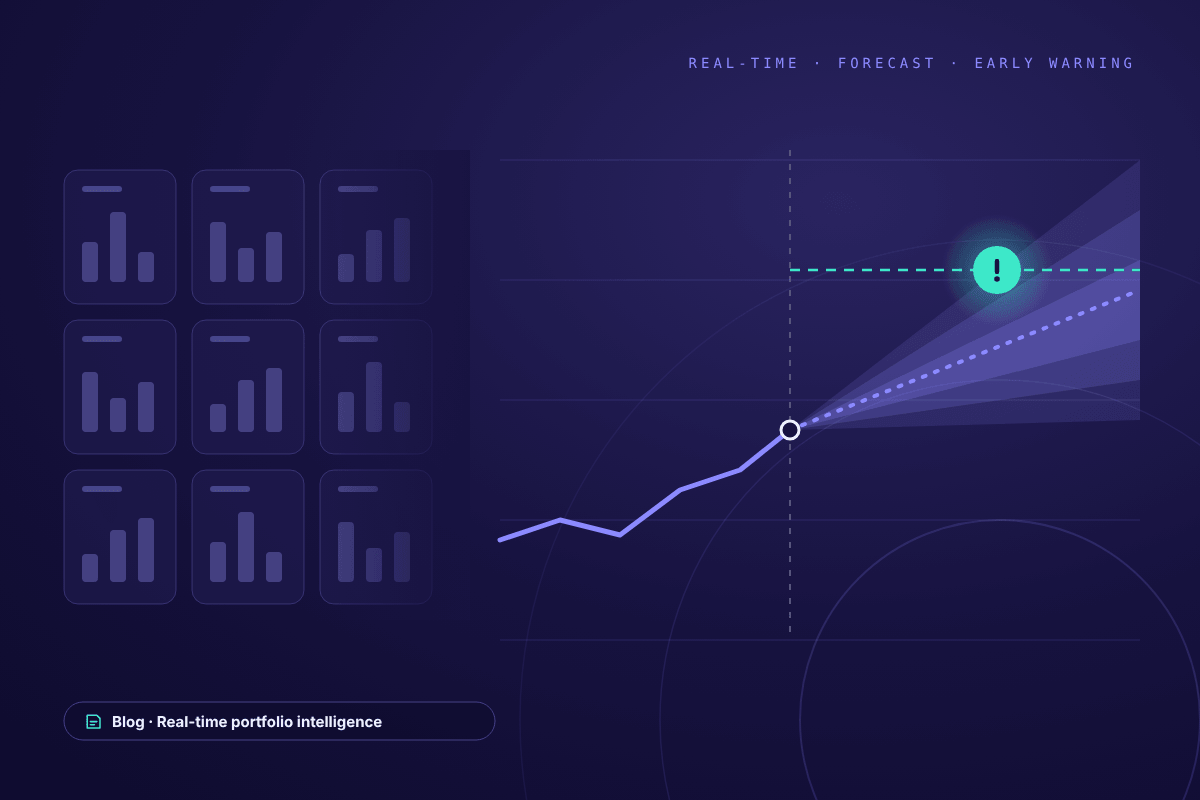
Real-time portfolio intelligence is the continuous use of live portfolio data, analytics, and AI to detect, forecast, and act on portfolio risk before it reaches a steering committee. A static dashboard shows what already happened. Real-time portfolio intelligence shows what is about to happen and what to do about it.
Most PMOs have spent the last decade building better dashboards. They are cleaner, faster, and better connected than they were, yet the questions leaders ask in portfolio reviews have not changed much: why did this program slip, why did no one flag it sooner, and what does it mean for the rest of the portfolio? Those questions point to a gap that a dashboard cannot close on its own.
Gartner’s 2026 research on AI-enabled portfolio risk management draws the line clearly. Periodic reviews and static risk registers can no longer keep up with how fast risks emerge, which creates blind spots that threaten portfolio value. This article explains what separates real-time portfolio intelligence from a static dashboard, how continuous portfolio monitoring and a portfolio early warning system work in practice, and what Gartner says AI changes for PMO leaders.
Key takeaways
A static dashboard refreshes numbers. Real-time portfolio intelligence interprets them, forecasts where they are heading, and recommends action, which is the difference Gartner draws between deploying AI as a reporting tool and redesigning decisions around it.
Continuous portfolio monitoring replaces the monthly or quarterly review cycle with always-on analysis of schedule, cost, resource, and dependency data, so leaders see emerging risk weeks earlier.
A portfolio early warning system uses leading indicators and proactive alerts to flag rising risk probability, rather than waiting for a red status that arrives after the damage is done.
Probabilistic forecasting replaces single-point estimates with outcome ranges, giving executives a realistic view of portfolio value at risk instead of false precision.
Gartner is direct about the stakes: organizations that redesign portfolio decision making around AI-driven risk intelligence gain a sustained decision advantage over those that treat AI as another reporting layer.
Static dashboards report the past and real-time portfolio intelligence forecasts what comes next
A dashboard is a display layer. It pulls portfolio data from project schedules, timesheets, and financial management systems, then arranges that data into charts and status tiles. Even a well-built dashboard with a nightly refresh is a mirror pointed backward.
Real-time portfolio intelligence adds three things a dashboard does not have: continuous analysis, forecasting, and decision support. It uses AI to analyze portfolio data as it changes, estimates the likelihood of different outcomes, and surfaces actionable insights in the place where leaders make decisions.
A dashboard refreshes data and portfolio intelligence interprets it
The distinction sounds subtle until you sit in a portfolio review. A dashboard can show that a capital program is 12% behind schedule. Portfolio intelligence tells you that the same program now has a 35% probability of missing its commissioning date, that two dependent projects share its constrained engineering resource, and that the combined exposure puts a strategic objective at risk.
That second version is what Gartner calls risk intelligence. The first is reporting. Gartner’s guidance is that organizations that deploy AI as a reporting tool will realize limited benefits, while those that redesign decisions around AI-driven risk intelligence gain a lasting advantage.
Reporting lag turns known risks into surprises
Static reporting has a built-in delay. A project manager updates status on Friday, the PMO consolidates on Monday, the slide deck is built on Wednesday, and the steering committee meets the following week. By then the data is ten days old and the underlying situation has often moved again.
Gartner describes the outcome plainly: escalating delivery failures despite improved governance rigor, capital misallocated because risk exposure was never quantified, and leadership decisions made on incomplete or outdated information. None of those problems is solved by a faster dashboard. They are solved by changing when and how the portfolio gets analyzed.
Continuous portfolio monitoring closes the gap between portfolio reviews
Continuous portfolio monitoring is the practice of analyzing portfolio performance in real time rather than at fixed reporting intervals. It does not remove the governance cadence. It fills the space between meetings with live analysis, so that when the steering board convenes it is deciding rather than discovering.
Gartner recommends starting with the data organizations already have. Most PMOs already hold the leading indicators they need, spread across scheduling, financial, resource, and operations management systems. The first step is bringing that portfolio data into one connected model, which is the same principle behind Cora’s project portfolio management software.
Leading indicators feed the monitoring layer
Gartner identifies the leading indicators that matter most for AI-enabled risk sensing: schedule variance, resource shortages, dependency delays, and budget changes. These are the signals that move before a milestone is missed. A continuous portfolio monitoring layer watches them every day rather than once a month.
The Gartner report also recommends ingesting unstructured data such as risk narratives and meeting notes alongside structured schedules and budgets. Natural language processing can pull recurring concerns, sentiment shifts, and emerging risk themes from that text. A dashboard has no way to read a status commentary; a real-time portfolio intelligence platform can.
Automated pipelines replace manual status collection
Manual status collection is the reason most portfolio reporting is late. Automated data pipelines keep real-time data flowing into the portfolio model without depending on someone remembering to run an export. Gartner lists this as a core requirement for continuous risk sensing.
In practice this means integrating the PPM platform with the systems where work actually happens: ERP for financial actuals, HR systems for resource availability, and scheduling tools for progress updates. Cora’s integrations exist for this reason. Once the pipeline runs on its own, the PMO stops chasing updates and starts analyzing them.
A portfolio early warning system turns signals into proactive alerts
A portfolio early warning system is the alerting layer of real-time portfolio intelligence. It watches leading indicators, calculates whether the probability of an adverse outcome is rising, and notifies the right decision maker before the risk becomes an issue. Gartner frames this as the shift from risk logging to risk prediction and prevention.
The word “early” is the point. A red status on a dashboard is a lagging indicator; it appears after the milestone is missed. An early warning fires when the pattern that precedes a missed milestone starts to form.
Proactive alerts beat red, amber, and green status
Traditional RAG status depends on a project manager’s judgment and often on their optimism. Proactive alerts depend on data. When resource utilization on a critical path crosses a threshold, or when a supplier dependency slips for the third week running, the system raises the flag rather than waiting for someone to admit the problem.
Gartner’s guidance is to use machine learning, anomaly detection, and pattern recognition to identify emerging risks across the data, then trigger alerts when leading indicators suggest a rising probability of adverse outcomes. That is a smart layer on top of the data, not a prettier view of it.
Probabilistic forecasting shows the range of outcomes
Single-point forecasts are the quiet weakness of most portfolio reporting. A dashboard says the program finishes in September. Gartner’s recommendation is to replace that with confidence-based outcome ranges, so leaders can see the likelihood of completion across different timeframes given current risk conditions.
Simulation techniques such as Monte Carlo-style analysis model multiple delivery scenarios instead of one. Gartner also notes that these models should show how interconnected risks propagate across initiatives, so a delay in one program is understood through its knock-on effect on the rest of the portfolio. That is real-time multi-dimensional portfolio analysis, and it is not something a static chart can do.
Gartner adds a caution here that PMO leaders should take seriously. AI outputs can create false precision if assumptions, confidence ranges, and model limitations are hidden. A forecast that looks exact on screen is only as reliable as the data and assumptions behind it, which is why the platform should show both.
Gartner research shows AI changes how PMOs manage portfolio risk
AI adoption in program and portfolio management is accelerating, according to Gartner’s 2026 AI use-case assessment, as PPM leaders look for efficiency, better decision accuracy, and more time for higher-value work. The same research finds that most PPM organizations are underprepared to integrate advanced AI because of gaps in AI-ready data, process maturity, and change management readiness.
Right now, most deployed use cases sit at the project manager level: documentation, status reporting, and knowledge management. Real-time portfolio intelligence is the next step up, moving AI from helping write the status report to deciding whether the status report is telling the truth.
Gartner’s four recommended actions for AI-enabled portfolio risk management read like a specification for real-time portfolio intelligence:
Implement continuous risk sensing across the portfolio by integrating internal delivery indicators with external signals.
Adopt probabilistic forecasting and replace single-point estimates with confidence-based outcome ranges.
Embed AI-driven insights directly into portfolio reviews so initiatives are prioritized on risk-adjusted value.
Align risk metrics with enterprise value realization by tracking strategic objective impact and portfolio value at risk.
The direction of travel matters for platform selection too. Gartner’s application strategy research reports that nearly half (47%) of professionals expect AI agents to replace at least 35% of enterprise applications within four years. A PPM platform built on a governed, connected data model is far better placed for agentic AI than a reporting tool bolted onto disconnected spreadsheets.
Real-time portfolio intelligence for PMOs differs from financial portfolio tools
Search for “real-time portfolio intelligence” and many of the results describe investment tools. Private equity firms use them to track portfolio companies, asset managers use them for real-time NAV calculation, and wealth apps use them to follow market data through the trading day. Those tools are built for a different portfolio.
A PMO’s portfolio is made of projects, programs, and capital investments, not securities. The intelligence it needs comes from schedule, cost, resource, and benefits data, and from external signals such as regulatory, supply-chain, and market conditions that Gartner recommends integrating into risk sensing. The goal is to forecast portfolio risk to delivery and strategic outcomes, not to price a deal.
The two fields do share a principle. In both cases, the organizations that win are the ones that stopped waiting for the monthly pack. A capital projects leader running a multi-year program deserves the same real-time insights that a fund manager expects, applied to the portfolio they actually run.
Decision intelligence, not more reporting, is what leaders need
Decision intelligence is the practical outcome of real-time portfolio intelligence. It means the analysis arrives inside the decision, not in a separate report that someone has to interpret. Gartner is explicit that AI-generated risk insight only creates value when it influences decisions rather than becoming a compliance checkbox.
For the board and the executive team, that changes what a portfolio review looks like. Instead of walking through 40 status tiles, the review starts with the five initiatives where value at risk has moved, the risk-adjusted case for each, and the response options already modeled. Revenue impact, operations impact, and investment return sit alongside schedule and cost, so the board sees the whole picture.
Governance keeps AI-generated insights trustworthy
Gartner’s guidance on AI agents applies directly here. PMOs that deploy AI agents without solid foundations risk autonomous systems making poor decisions across the portfolio at scale, and Gartner’s view is that the gap between generative AI and agentic AI is almost always a data and integration problem.
Governance research from Gartner adds the warning that AI agents are being deployed faster than AI governance is adapting. For a PMO, that means transparency into how a recommendation was generated, clear ownership of the data feeding it, and human oversight of any action taken. Cora’s Security Center and platform controls are built around that principle.
People adopt what they trust
Gartner’s research on AI capabilities for PMO staff argues that adopting AI tools is no longer a differentiator by itself. The advantage sits with the people who can shape how AI is used to deliver outcome-driven insight. Real-time portfolio intelligence works when project managers, planners, and analysts trust the alerts enough to act on them.
That trust is built through hands-on use in real work rather than one-off training, according to Gartner. Nearly 90% of workers say they are motivated to use AI, so the barrier is rarely willingness. The Gartner report on portfolio risk recommends training leaders to interpret probabilistic outputs, sharing the evaluation model and explainability standards, and iterating the models as feedback comes in.
How Cora Systems can help
Cora Systems delivers real-time portfolio intelligence through a single connected PPM platform rather than a reporting layer sitting on top of disconnected tools. Project, program, financial, resource, and risk data live in one model, which gives PMOs one real-time view of the portfolio and the foundation Gartner describes as the prerequisite for AI-enabled risk management.
The Data Analytics & AI module turns that foundation into continuous portfolio monitoring, with portfolio analytics, configurable proactive alerts, and forecasting that shows outcome ranges rather than single dates. The Assistant module brings AI directly into day-to-day work, so the business intelligence a leader needs is available in context rather than in a separate report. Portfolio managers can track investment, revenue, and operations impact from the same smart analytics layer that raises the alert.
For organizations managing large capital programs, Cora’s strategic portfolio management software connects portfolio risk to strategic objectives and benefits, which is how Gartner recommends measuring value at risk. Cora also publishes practical guidance on building the data foundations AI depends on and on the broader shift to continuous portfolio intelligence.
Conclusion: request a Cora Systems demo
Static dashboards were a real improvement over slide decks, but they still leave PMO leaders reacting to what already happened. Real-time portfolio intelligence, built on continuous portfolio monitoring and a portfolio early warning system, gives leaders the earlier view Gartner says now separates organizations that protect portfolio value from those that lose it.
The organizations gaining ground are not the ones with the most dashboards. They are the ones that put AI-driven risk intelligence inside how decisions get made.
See how Cora turns live portfolio data into forecasts, proactive alerts, and decisions your steering board can act on. Request a demo and we will walk through your portfolio, your data, and what an early warning would have looked like on your last surprise.
Sources referenced
Gartner, “How to Use AI to Improve Portfolio Risk Management and Protect Value,” by Cynthia Phillips and Zahid Kisa, 30 June 2026, ID G00856584. Gartner, “AI Use-Case Assessment for Program and Portfolio Management Processes,” by Peter Clegg, Shivica Mathur and 1 more, 17 July 2026, ID G00851458. Gartner, “Build Effective PPM AI Agents to Improve PMO Decisions & Capacity,” by Peter Clegg, Aditi Pant and 1 more, 21 July 2026, ID G00855505. Gartner, “Key AI Capabilities for PMO Staff,” by Shivica Mathur, Jennifer Jackson and 1 more, 26 June 2026, ID G00855985. Gartner, “It’s Go Time: 3 Steps to Build an AI-Amplified Workforce Starting Today,” by Tori Paulman, Mary Mesaglio and 1 more, 15 June 2026, ID G00844622. Gartner, “Strengthen AI Governance to Manage Agentic AI Risks,” by Stuart Strome, James Crocker, 8 July 2026, ID G00851162. Gartner, “The New Application Strategic Framework for Build vs. Buy With AI,” by Tad Travis, Jason Wong and 1 more, 20 July 2026, ID G00846875.
Gartner is a registered trademark of Gartner, Inc. and/or its affiliates and is used herein with permission. All rights reserved.