


Selecting the wrong project management platform costs more than budget overruns. For PMO leaders running regulated, complex programs, a poor EVM fit can lead to inaccurate forecasts, audit failures, and loss of stakeholder confidence at the worst possible moment.
This guide walks through every dimension to evaluate when comparing project management software with built-in earned value management, from technical EVM calculations to reporting governance and vendor support depth.
Key takeaways
EVM is non-negotiable for regulated programs: cost and schedule integration must be native, not bolted on.
A true EVM platform calculates CPI, SPI, TCPI, and VAC automatically from live data; manual spreadsheet inputs are a red flag.
Reporting must serve two audiences: executive dashboards for decisions and detailed variance analysis for project controls teams.
Scalability across a portfolio of 50+ projects separates enterprise EVM tools from mid-market project trackers.
Vendor experience in your specific industry (Aerospace & Defense, Engineering, Government Contracting) matters as much as the feature set.
Why PMO leaders need EVM built into their project management software
Earned value management is a discipline, not a feature checkbox. It ties scope, schedule, and cost into a single measurement framework, giving project controls teams the data to answer whether a program is on track and what it will cost to complete.
PMO leaders in regulated industries face contract reporting obligations, executive steering committees, and audit trails that require on-demand EVM data. Pulling that data from disconnected tools (scheduling in one system, cost tracking in another, reporting in a spreadsheet) creates reconciliation risk and eats analyst time.
Purpose-built project management software with earned value management eliminates that gap. The software should calculate Planned Value (PV), Earned Value (EV), and Actual Cost (AC) from live project data, not from figures someone enters after the fact.
Must-have earned value management (EVM) features in any shortlisted tool
Not every vendor that claims EVM support actually delivers it. Before you schedule a demo, build a checklist of non-negotiable calculations and workflows.
Core EVM metric calculations
The platform must compute the following automatically from schedule and cost data:
Cost Variance (CV = EV - AC)
Schedule Variance (SV = EV - PV)
Cost Performance Index (CPI = EV / AC)
Schedule Performance Index (SPI = EV / PV)
Estimate at Completion (EAC), with support for multiple calculation methods (budget / CPI, AC + ETC, etc.)
To-Complete Performance Index (TCPI)
Variance at Completion (VAC)
If a vendor cannot demonstrate these calculations populating automatically from an updated schedule, move on.
Work Breakdown Structure (WBS) and Control Accounts
EVM requires a well-structured WBS mapped to control accounts with assigned budgets and responsible managers. The software should enforce this hierarchy, not just allow free-form task entry. Look for the ability to set Performance Measurement Baselines (PMBs) and lock them for audit purposes.
Baseline management and change control
Every scope change needs to flow through a formal baseline change process. The system should record the original baseline, the approved change, and the revised baseline, with a complete history. This is a hard requirement for ANSI/EIA-748 compliance and for US Federal Government and defense contracts.
Earned value techniques (EVTs)
Programs use different EVTs depending on work type: 0/100, 50/50, percent complete, milestones. The platform should support all standard techniques and allow assignments at the work-package level.
How to structure your project management software comparison
A side-by-side feature comparison shows what a tool offers. A structured evaluation process tells you whether it actually works for your programs.
Step 1: Define your evaluation criteria before you talk to vendors
PMO leaders who start with vendor demos end up comparing sales pitches. Build your criteria first: EVM depth, integration requirements, reporting governance, user access controls, and industry compliance. Weight each criterion by importance to your programs.
Step 2: Validate EVM calculations with your own test data
Take a real (anonymized) program dataset and run it through each platform. Check whether CPI and SPI match your manual calculations. Check whether the software handlespartial-periodd actuals correctly, manages open work orders, and handles retroactive baseline changes without corrupting history.
Step 3: Stress-test the portfolio view
Single-project demos always look clean. Ask to see a portfolio of 50+ projects with mixed status, late baselines, and multiple currencies. That is where schedule integration and rollup calculations either hold up or fall apart.
Step 4: Evaluate the reporting governance model
Who can change the baseline? Can a project manager override an EAC without PMO approval? Good software enforces workflow; it does not rely on user discipline to maintain data integrity.
Step 5: Check integration with your existing systems
Your EVM platform needs to exchange data with your ERP (SAP, Oracle, Costpoint), your scheduling tools (Primavera P6, Microsoft Project), and your financial reporting systems. Ask for documented API specs and reference customers who run the same stack.
Project cost and schedule tracking: what separates good from great
Most project management tools track costs. Fewer integrate costs with schedule data in a way that supports genuine EVM analysis.
Time-phased budgets
The system must support time-phased budgets, budgets distributed across periods, not just a single lump sum per task. Without time-phased data, PV cannot be calculated correctly, and every downstream EVM metric is wrong.
Actual integration from financial systems
Manual cost entry is the enemy of accurate EVM. The platform should pull actuals directly from your ERP or timesheet system on a defined cadence. Look for automated reconciliation between project actuals and GL postings.
Schedule-cost integration
Schedule updates must flow into EVM calculations without manual re-entry. If a project manager slips a milestone by two weeks in the scheduling tool, the SV should update automatically. This sounds basic; many platforms do not do it.
For more on connecting schedule data to portfolio-level reporting, see Cora's approach to transforming scheduling management
EVM reporting and dashboards: what PMO leaders should demand
Reporting is where EVM value is realized or wasted. A platform that calculates correctly but reports poorly gives your executives a spreadsheet problem, not a solution.
Executive-level portfolio dashboards
Executives need a single view that shows CPI and SPI by program and flags programs outside acceptable thresholds. Color-coded health indicators are useful, but only if the thresholds are configurable and tied to real contract requirements rather than generic defaults.
Project controls-level variance analysis
Project controls teams need access to control account-level detail: CV, SV, EAC, ETC by WBS element, with trend lines across reporting periods. The ability to drill from portfolio summary down to work package is non-negotiable.
Forecasting and what-if analysis
The best EVM platforms let analysts run EAC scenarios using different CPI assumptions or productivity adjustments. This capability is the difference between reporting what happened and advising on what to do next.
Export and compliance reporting
For US Federal Government and defense contracts, the platform must support IPMR (Integrated Program Management Report) format outputs and, where required, DCMA 14-Point Assessment data. Ask specifically whether the vendor has delivered compliant reporting for contracts under DoDI 5000.81.
To understand how data strategy drives better reporting outcomes, see 'Making data a strategic asset.'
Project performance measurement: building a repeatable assessment framework
EVM metrics are only as reliable as the process that generates them. When comparing platforms, evaluate whether the software supports a repeatable, auditable performance measurement process, not just a set of calculations.
Variance analysis workflows
After the EVM data is calculated, someone needs to write a variance analysis that explains why the CV is negative, what corrective action is planned, and what the revised ETC is. The platform should capture this narrative alongside the numbers, time-stamp it, and link it to the specific control account. Variance analysis buried in an email is not auditable.
Rolling wave planning support
Large programs cannot be fully planned at the work-package level from day one. The platform should support rolling wave planning, allowing near-term work to be planned in detail while far-term work sits at a higher WBS level, without corrupting the PMB.
PMO maturity and process enforcement
A platform should grow with your PMO. For teams still building EVM capability, configurable workflows that enforce data entry discipline matter as much as advanced analytics. For mature PMOs, the priority shifts to automation and exception-based management. See what PMO maturity looks like and how to improve it for a framework that maps directly to platform requirements.
Industry-specific requirements: Aerospace & Defense, Government Contractors, and regulated enterprises
Standard project management platforms are built for general commercial use. Regulated industries have requirements that go well beyond standard feature sets.
Aerospace & Defense and Government Contractors
Compliance with ANSI/EIA-748 Earned Value Management System (EVMS) guidelines is a contract requirement on many programs. The platform must support the 32 EVMS guidelines, from planning and scheduling through analysis and reporting. DCMA surveillance access and audit trails are also common requirements.
For a deeper look at workforce and program challenges in the sector, see tackling workforce shortages in Aerospace & Defense.
Manufacturing and capital projects
For manufacturing PMOs, EVM needs to integrate with production schedules and material cost data. Capital project teams need support for multi-phase programs with stage-gate reviews and funding releases tied to performance milestones.
See keys to achieving PPM success in manufacturing for context on how manufacturing PMOs structure their portfolio processes.
How Cora Systems can help
Cora Systems builds project portfolio management software for PMO leaders running complex, regulated programs. The platform delivers native EVM, not a plug-in or an add-on, with time-phased budgeting, automated actuals integration, baseline management, and full EVMS guideline support.
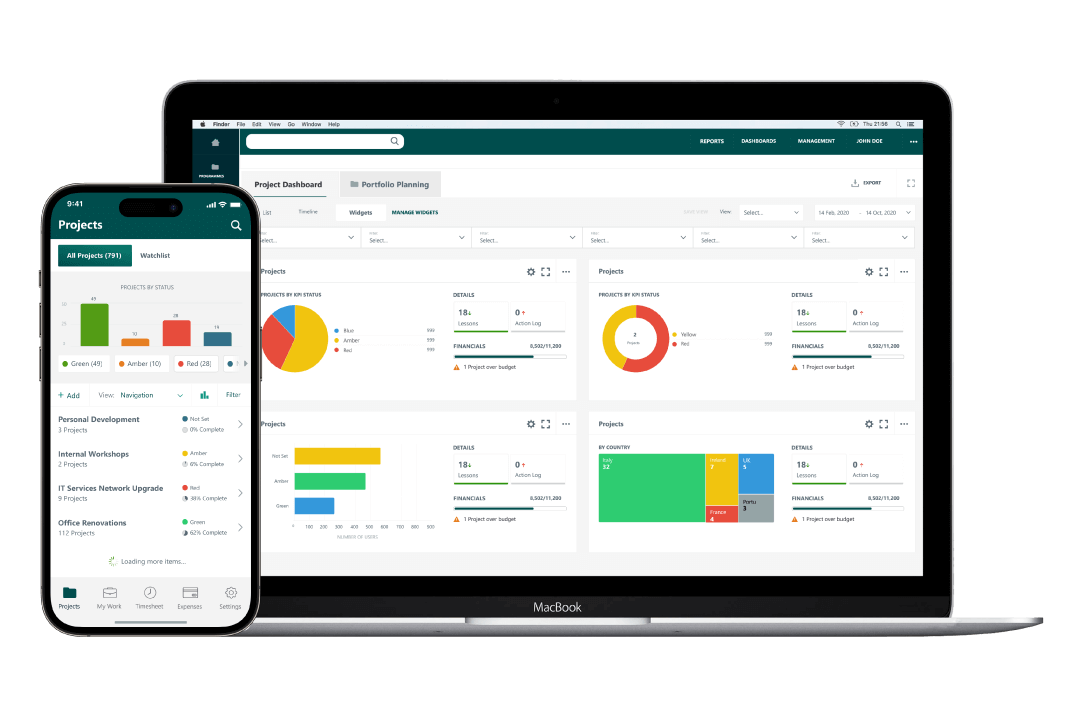
Cora's EVM module calculates all standard performance indices from live schedule and cost data, with configurable variance thresholds, workflow-enforced change control, and portfolio-level dashboards that provide executives and project controls teams with different yet connected views of the same data.
To see how Cora fits your specific program environment, explore the Cora Systems platform.
Request a demo, see Cora's EVM capabilities in your programs
The comparison process described in this guide works best when you can test each platform against real program data. Cora Systems offers structured evaluation sessions with your own datasets, not just a standard product walk-through.
If you lead a PMO in Aerospace & Defense, Government Contracting, engineering, or capital projects and need a platform that meets EVMS compliance requirements from day one, request a Cora demo to see how the EVM module handles your specific reporting and governance requirements.