


Why Real-Time Budget Control Defines Capital Project Success
Capital projects fail on cost far more often than they fail on scope. A 2023 McKinsey analysis found that major infrastructure and industrial programs run 79% over budget on average. The root cause is almost always the same: teams discover budget problems weeks or months after the money is already spent.
Real-time cost and budget tracking changes that dynamic. When actuals flow directly from ERP systems into your capital project management software, the gap between what was planned and what is happening shrinks from weeks to hours.
AI now extends that advantage from cost tracking to risk. New Gartner research, How to Use AI to Improve Portfolio Risk Management and Protect Value, finds that portfolio risks now emerge faster than traditional governance cycles can detect them.
For PMO leaders managing multi-year CapEx portfolios, real-time project dashboards and AI-driven risk intelligence are not features. They are control requirements.
Key Takeaways
Real-time cost and budget tracking closes the gap between committed spend and actual project performance before overruns become unrecoverable.
AI-enabled risk management replaces periodic reviews with continuous risk sensing and probabilistic forecasting, which Gartner links to a sustained decision advantage.
Project dashboards connected to ERP data give project managers, PMO leaders, and executives one at-a-glance view of project status, cost, and schedule health across the portfolio.
EVM-ready controls give PMO leaders standardized performance metrics that satisfy auditors, boards, and government contracting requirements.
Purpose-built capital project management software outperforms generic tools and spreadsheet templates by supporting change order workflows, forecast-at-completion modeling, and risk-adjusted prioritization from a single platform.
CapEx Project Management Demands More Than Standard PM Tools
Generic project management platforms were built for software delivery, marketing campaigns, and internal initiatives. CapEx project management operates under a different set of rules.
Capital programs involve committed purchase orders, earned value reporting, change order approvals, drawdown schedules, and regulatory compliance checkpoints. A task board cannot manage any of that, and basic task management tools cannot track spend against a cost baseline.
The distinction matters because choosing the wrong platform forces teams to build manual workarounds. Those workarounds introduce the very data delays the software was supposed to eliminate.
Cora Systems was purpose-built for organizations running large capital programs. The platform handles the full controls lifecycle, from budget baseline through final account close, without requiring bolt-on integrations or spreadsheet bridges.
AI Is Changing How Capital Programs Manage Portfolio Risk
Traditional portfolio risk management relies on periodic reviews, static risk registers, and subjective assessments. Gartner argues this approach can no longer keep pace because risks now emerge faster than governance cycles can detect them.
For capital programs, that gap is expensive. A supply chain disruption, a regulatory change, or a contractor failure can erode value for weeks before it shows up in a monthly report.
Periodic Reviews Leave Capital Programs Exposed Between Governance Cycles
Gartner warns that organizations that fail to modernize risk management will see a widening divergence between planned and realized portfolio value. The report links outdated approaches to escalating delivery failures, misallocated capital, and leadership decisions based on incomplete information.
The Gartner analysts put the choice plainly:
"Organizations that deploy AI as a reporting tool will realize limited benefits; while organizations that redesign portfolio decision making around AI-driven risk intelligence will gain a sustained decision advantage."
Capital program leaders who treat AI as one more reporting layer will miss most of the value.
Gartner Recommends Four Actions for AI-Enabled Risk Management
Gartner outlines four actions for organizations building AI-enabled risk management. The table below maps each action to what it means for capital project controls.
Gartner action | What it means for capital project controls |
|---|---|
Implement continuous risk sensing | Combine internal delivery indicators, like schedule variance and committed cost, with external signals such as supply chain, regulatory, and geopolitical events |
Adopt probabilistic forecasting | Replace single-point completion dates and cost estimates with confidence-based outcome ranges |
Embed AI-driven insights into portfolio reviews | Prioritize capital initiatives by risk-adjusted value rather than business cases alone |
Align risk metrics with value realization | Track how risks affect strategic objectives, expected benefits, and total portfolio value at risk |
Clean Data and Visible Assumptions Make AI Risk Insights Trustworthy
Gartner also flags three cautions. AI outputs can create false precision when assumptions and confidence ranges are hidden, poor-quality or fragmented data reduces prediction accuracy, and organizations that do not adapt governance practices will underrealize the value.
Other Gartner research reinforces the data point. In AI Use-Case Assessment for Program and Portfolio Management Processes, Gartner notes that
"Most PPM organizations are underprepared to integrate advanced AI capabilities due to gaps in AI-ready data, internal process maturity, and change management readiness."
That is why real-time, ERP-connected cost data matters so much for capital programs. AI can only forecast what your data can describe.
Real-Time Cost Tracking Replaces Month-End Surprises With Daily Control
Live Budget-to-Actual Reconciliation Replaces Weekly Spreadsheet Runs
When ERP transactions post, capital project management software that is properly connected updates committed costs, actual costs, and remaining budget in real time. Project controllers no longer need to export ledger data, reformat it, and import it into a separate reporting tool.
The result is a single source of financial truth that any stakeholder can access without having to call the finance team. For construction project controls specifically, where subcontractor invoices and material deliveries hit the ledger daily, this matters.
Cora's Financial Control capabilities keep committed and actual costs aligned at the WBS level. Controllers work from the same numbers finance reports to the board.
Forecast-at-Completion Modeling Updates Automatically
Cost-to-complete projections that depend on stale actuals are misleading. When actuals update continuously, your forecast-at-completion reflects the project as it actually stands today, not as it stood at last month's progress meeting.
PMO leaders can model multiple completion scenarios, compare them against the approved budget, and escalate before a variance becomes a write-off.
Probabilistic Forecasting Gives Leaders Confidence Ranges Instead of Single Dates
Gartner recommends replacing single-point forecasts with confidence-based outcome ranges. Instead of forecasting that a capital project will finish in September, leaders can see the likelihood of completion within different windows based on current risk conditions.
Simulation techniques such as Monte Carlo analysis estimate the probability of hitting schedule, cost, and benefit targets. Probabilistic project forecasting also shows how risk in one initiative can spread across the wider portfolio.
Project Dashboards Turn Live Cost Data Into Faster Decisions
Project Dashboards Give Stakeholders an At-a-Glance View of Project Health
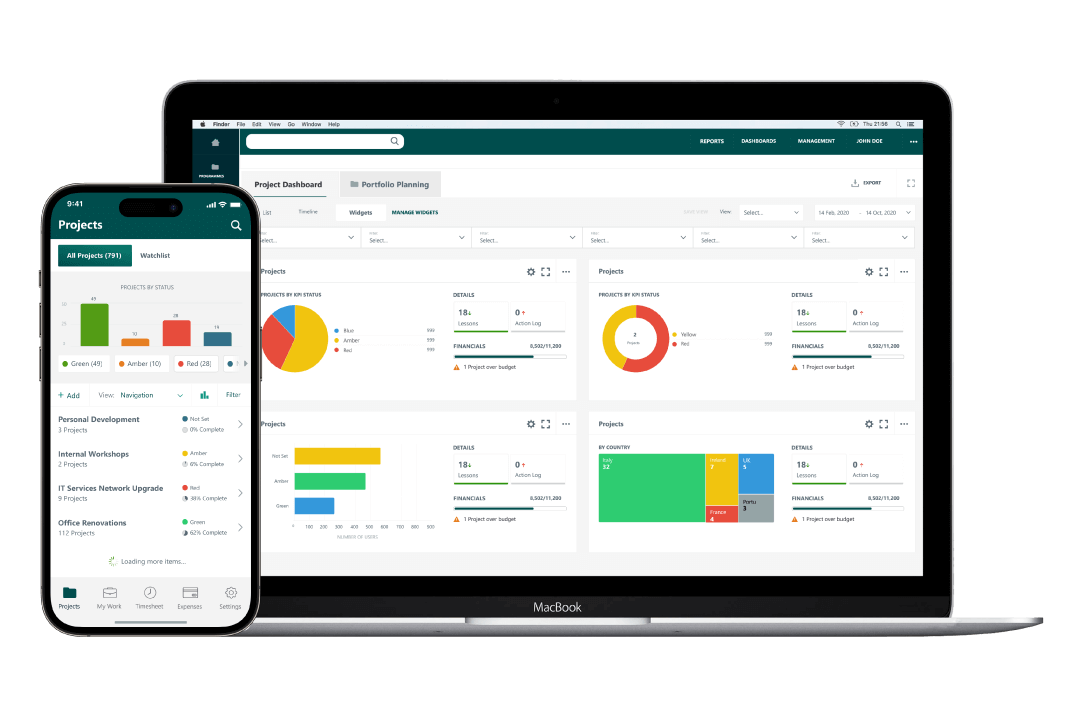
Project dashboards provide digital, at-a-glance displays of the critical data project managers and executives need to track progress. A well-built project dashboard pulls project status, cost performance, schedule health, risks, and resource demand into one summary view that users can read in seconds.
For capital programs, your project dashboard should show each project's key performance indicators, including CPI, SPI, estimate at completion, committed versus actual cost, and open change orders. Real-time dashboards refresh those project metrics as data changes, so stakeholders see the same information the controls team sees.
Four Dashboard Types Serve Different Capital Program Decisions
Most dashboard examples fall into four main types. Capital programs need all four, each set up for a different audience.
Strategic dashboards give executives an at-a-glance overview of portfolio value, capital allocation, and progress against strategic objectives.
Operational dashboards help project managers and teams track daily tasks, work completed, and project progress against the schedule.
Analytical dashboards let project controls teams study trends in cost, variance, and risk data to find root causes.
Tactical dashboards give PMO leaders and program heads a mid-level view of project performance across a program or business unit.
Spreadsheet Dashboard Templates Break Down at Capital Program Scale
Many dashboard project ideas start with free project dashboards templates in Excel or a project management dashboard built in Power BI. A simple project status dashboard template in Excel works for a single project with a small team.
Capital programs with dozens of concurrent projects outgrow that approach quickly. Someone has to refresh the data by hand, formulas break as the WBS changes, and the view is out of date by the time it reaches stakeholders.
Purpose-built management dashboards draw from the same system that holds cost, schedule, and resource data. Cora's Data Analytics & AI capabilities give project management and PMO dashboards a live connection to the source, with no copy-and-paste step in between.
AI-Driven Dashboards Flag Emerging Risks Between Reviews
Gartner recommends ingesting structured data, such as schedules, budgets, and resource utilization, alongside unstructured data, such as risk narratives and meeting notes. Natural language processing can pull themes, sentiment changes, and recurring concerns from that text.
When AI sits behind capital projects dashboards, anomaly detection and pattern recognition can trigger alerts as leading indicators point toward an adverse outcome. Continuous risk sensing gives PMOs that earlier warning, and an AI-powered portfolio risk dashboard puts it in front of decision makers.
EVM-Ready Controls Support Regulated Capital Programs
Earned Value Management (EVM) is mandatory for US federal government contracts above certain thresholds and is increasingly required by boards and lenders for large private-sector capital investments. EVM ties cost performance to schedule performance, which means a project that is on budget but behind schedule surfaces as at-risk, not as healthy.
Cora's project portfolio management platform natively calculates the Schedule Performance Index (SPI), Cost Performance Index (CPI), and Estimate at Completion (EAC). Project controls teams do not need to export data to spreadsheets to generate EVMS-compliant reporting.
For Aerospace and Defense contractors and US Federal Government programs, where DCAA audit readiness is non-negotiable, having EVM built into the core platform rather than layered on top materially reduces compliance risk. Government contractors can see how Cora's Earned Value Management and Cora GovCon support those requirements.
Portfolio Visibility Covers Every Active Capital Project
Individual project dashboards show whether a specific program is on track. Portfolio-level visibility shows whether the organization as a whole is on track.
The difference matters when resources are shared across projects, when risk events in one program affect funding availability for others, or when the board wants a single-page view of total CapEx exposure relative to approved budgets.
Resource and Budget Conflicts Surface Before They Become Crises
Capital projects management at portfolio scale requires the ability to see every project's budget status, schedule health, and resource demand in one place. When a project enters a critical phase and pulls engineers or procurement staff away from another program, the portfolio view immediately makes that conflict visible.
Without that visibility, PMO leaders learn about resource conflicts only from phone calls. With it, they see them on a dashboard and can reallocate before schedules slip, using Cora Workforce Planning to rebalance shared engineering and procurement capacity.
Cora's portfolio management capabilities give executives and PMO directors the consolidated view they need to make data-driven capital allocation decisions, not status-meeting updates.
Risk-Adjusted Value Guides Capital Allocation Decisions
Gartner advises evaluating initiatives by risk-adjusted value rather than business cases alone. For capital programs, that means ranking projects by expected benefit after accounting for the probability of cost and schedule slippage.
Gartner also recommends mapping portfolio risks to strategic objectives, benefits, and enterprise KPIs, then measuring value at risk at initiative, portfolio, and enterprise levels. Strategic portfolio management software connects those layers so investment and reprioritization decisions reflect current risk exposure.
ERP-Connected Reporting Eliminates Manual Reconciliation
Most large capital programs run SAP, Oracle, or Microsoft Dynamics as their financial system of record. The problem is that those platforms were designed for financial accounting, not project controls.
Extracting project-level cost data from an ERP and turning it into actionable control reporting requires either a dedicated reporting layer or a capital project management software platform that connects directly to the ERP.
Cora integrates with major ERP platforms to pull actuals, commitments, and purchase orders directly into the project controls platform. Finance teams stop spending days each month reconciling two systems. PMO leaders get reports that match the ledger rather than approximate it.
This integration is particularly valuable for construction project controls, where contract values, change orders, and retention all need to reconcile precisely with the financial system.
ERP connectivity also lays the groundwork for AI. In Build Effective PPM AI Agents to Improve PMO Decisions & Capacity, Gartner states that
"The gap between generative AI (GenAI) and agentic AI is almost always a data and integration problem."
Construction Project Controls Solve the Change Order Problem
Change orders are among the leading causes of CapEx overruns in construction programs. A scope change that is not priced, approved, and reflected in the cost baseline within days of its identification can lead to significant budget exposure by the time it surfaces in financial reporting.
Capital project management software with built-in change control workflows routes change requests through the appropriate approval chain, updates the cost baseline upon approval, and creates an audit trail to support claims resolution. Without that workflow, change orders live in emails and shared drives until someone manually updates a spreadsheet.
Engineering and construction teams also use Cora Subcontractor Management to tie subcontractor commitments and claims back to the same cost baseline.
Adoption and Governance Decide Whether AI Delivers Value
Gartner notes that the greatest value comes when teams use AI-enabled risk capabilities inside real portfolio decisions. The report recommends sharing the risk evaluation model and explainability standards, training leaders to interpret probabilistic outputs, and refining models based on observed performance.
Governance matters more as AI agents enter PMO workflows. In Strengthen AI Governance to Manage Agentic AI Risks, Gartner cautions that
"AI agents are being deployed faster than AI governance is adapting."
Five Success Measures Show AI-Enabled Risk Management Is Working
Gartner says high-performing organizations will measure success by their ability to anticipate risk and protect portfolio value, not by the volume of risks tracked. Its five measures are forecast accuracy, earlier risk detection, portfolio decision quality, lower value at risk, and adoption of and trust in AI-driven insights.
For capital programs, practical metrics include the lead time between risk detection and cost impact and the share of risks caught by automated signals rather than manual reporting. Variance between forecast and actual cost at completion is another clear signal that AI is improving decisions.
How Cora Systems Can Help
Cora Systems provides project portfolio management software built specifically for organizations running complex capital programs. The platform covers the full controls lifecycle, from budget baseline and WBS setup through earned value reporting, change control, ERP integration, and executive portfolio dashboards.
Organizations in Aerospace and Defense, Energy and Utilities, Infrastructure, and Manufacturing use Cora to manage CapEx portfolios ranging from individual major projects to programs spanning hundreds of concurrent initiatives. The platform supports US Federal Government contracting requirements, including EVMS compliance and DCAA audit readiness.
To see how Cora maps to your specific capital program controls requirements, explore the full platform capabilities or review industry-specific solutions
Get a Demo of Cora's Capital Project Management Software
If your organization manages significant CapEx portfolios and your project controls team is still reconciling ERP data manually, running EVM in spreadsheets, or discovering budget problems late, Cora Systems is built to solve exactly that problem.
Request a personalized demo to see how Cora's real-time cost and budget tracking, EVM-ready controls, and portfolio visibility work together in your specific capital programs environment. Our team works with PMO leaders, heads of project controls, and finance executives to map platform capabilities directly to your program requirements before any commitment is made.
References
Gartner, "How to Use AI to Improve Portfolio Risk Management and Protect Value," Cynthia Phillips and Zahid Kisa, 30 June 2026, ID G00856584.
Gartner, "AI Use-Case Assessment for Program and Portfolio Management Processes," Peter Clegg, Shivica Mathur and 1 more, 17 July 2026, ID G00851458.
Gartner, "Build Effective PPM AI Agents to Improve PMO Decisions & Capacity," Peter Clegg, Aditi Pant and 1 more, 21 July 2026, ID G00855505.
Gartner, "Strengthen AI Governance to Manage Agentic AI Risks," Stuart Strome and James Crocker, 8 July 2026, ID G00851162.
Gartner is a trademark of Gartner, Inc. and/or its affiliates.