
Getting the balance between production capacity and resource management is always a challenge. Capacity planning software closes that gap by matching people, budget, and equipment to project demand before shortages surface. It is the discipline that keeps costs, timelines, and return on investment (ROI) under control.
AI now extends what capacity planning software can do. According to Gartner June 2026 report on AI-enabled portfolio risk management,
"AI enables continuous monitoring, probabilistic forecasting and decision support,"
incorporating external risks alongside internal delivery data. This guide breaks down how modern capacity planning software, sharpened by AI, helps PMOs protect portfolio value.
Whether you manage a single program or a global portfolio, the fundamentals stay the same: know what capacity you have, know what the pipeline needs, and close the gap before it becomes a missed deadline. What has changed is how much of that work AI can now do continuously, in the background, instead of during a once-a-month review.
Capacity Planning Software Delivers Five Advantages When Paired With AI
Predictive risk sensing: continuous monitoring of schedules, budgets, and external signals catches resource shortfalls before they hit the timeline.
Probabilistic forecasting replaces guesswork: confidence ranges show the likelihood of hitting a deadline instead of a single best-guess date.
Faster, evidence-based decisions: real-time dashboards let capacity planners and PMO leaders reallocate resource demand across the portfolio in hours, not weeks.
Stronger governance and audit trails: centralized capacity planning tools remove the spreadsheet silos that hide resource allocation errors.
Higher on-time delivery: PMI research shows organizations with a mature capacity planning process close projects on time far more often than their peers.
Strategic Capacity Management Aligns Resources With Long-Term Portfolio Goals
Strategic capacity management is the process of confirming you have the resources needed to complete projects efficiently. Capacity planning tools forecast resource utilization so leaders can plan ahead instead of reacting. The strategic planning process differs from both tactical resource planning and operational resource planning.
Strategic, Tactical, and Operational Resource Planning Operate at Different Levels of Detail
Strategic capacity planning focuses on provisioning employees or contractors with the right skills and building a working schedule that meets demand across a company's entire project portfolio. This is where capacity planning software begins, taking a long view of the project time frame. The goal is to keep current and future projects aligned with a company's strategic goals and match strategy to capacity requirements.
Tactical resource planning, by comparison, focuses on forming project teams, confirming team capacity, and committing resources to specific projects.
Operational resource planning targets individual projects at the task level.
Because each phase connects to the others, effective capacity planning in project management requires the right capacity planning tools and resource management tools.
Capacity Planning Software Delivers Measurable Business Benefits
Strategic capacity planning provides a more efficient way to manage resources and bring projects in on time and under budget. By anticipating needs, managing resources efficiently, and running scenarios to prepare for developing problems, PMOs realize several benefits:
Maximum Utilization Rates: capacity planning software lets teams get more done with the same people and resources.
Data-Driven Decisions: real-time data on production facilities, team members, and utilization increases the rate of on-time delivery.
Resource Demand Forecasting: complete visibility into resource demand, at both a high level and down to the individual project, sharpens the skill sets and lead strategy a PMO needs.
Workload Management and Capacity Tracking: balancing workloads across team, product line, project, and portfolio avoids task clashes and bottlenecks.
Scenario Modeling: analyzing short-term and long-term capacity planning scenarios shows the impact of a decision before it gets made.
Cora's Strategic Capacity Management tool gives PMOs control and visibility over resources across every business area. A complete overview of resource allocation and assignments means leaders always know current capacity and what they will need next, which helps avoid the resource conflicts that stall projects.
Teams know sooner whether they need to hire, add contractors, or reallocate resources to hit deadlines, cutting down on last-minute resourcing scrambles.
PMOs Run Into Five Common Capacity Planning Challenges
Resource Data Lives in Too Many Spreadsheets
Most PMOs already track resource allocation somewhere. The problem is that "somewhere" is often five different spreadsheets owned by five different project leads, none of which agree with each other by the time anyone checks.
Demand Forecasts Do Not Reach the People Who Set Priorities
A capacity planner can spot a coming shortfall weeks out, but if that forecast never reaches the portfolio review, the organization still finds out the hard way. Closing that gap between forecasting and decision-making is one of the biggest wins capacity planning software delivers.
Utilization Numbers Hide Who Is Actually Overloaded
Portfolio-level utilization percentages can look healthy while specific teams or specialists are quietly overbooked. Workload management tools need to break utilization down by person and role, not just by project, to catch this before it causes burnout or slipped deadlines.
Scenario Planning Happens Too Late to Matter
By the time most teams model an alternative resource plan, the decision has usually already been made informally. Capacity planning tools that support scenario modeling earlier in the review cycle give leadership real options instead of a rubber stamp.
Capacity Data and Financial Data Do Not Talk to Each Other
Resource plans and budget plans frequently live in separate systems, an ERP for finance and a project tool for schedule, which makes it hard to see the full cost of a resourcing decision. Connecting capacity planning software to financial data closes that gap.
The Right Capacity Planning Software Combines Six Core Features
Not every capacity planning tool on the market covers the full scope a PMO needs. Before choosing a platform, it helps to check for the following capabilities.
Buying decisions often start with a feature checklist and end up hinging on one question: does the software fit how the PMO actually runs its portfolio review. A tool with every feature on paper still falls short if capacity planners cannot get a clear resource demand picture in the time they have each week.
Resource Allocation and Capacity Tracking Across the Full Portfolio
A capacity planner needs to see committed, available, and at-risk resources in one view, not one project at a time. Capacity tracking should roll up from the individual task to the full portfolio, so a shortage in one program is visible before it drags down another.
Demand Planning That Looks Beyond the Current Quarter
Demand planning matches upcoming project pipeline against the skills and headcount already on hand. Strong capacity planning software forecasts resource demand months ahead, giving PMOs time to hire, contract, or reprioritize instead of reacting at the last minute.
Workload Management Built for Distributed Teams
Workload management tools should show utilization by person, team, and role, flagging overallocation before it causes burnout or missed deadlines. This matters as much for a manufacturing capacity planning team on a shop floor as it does for a distributed engineering group.
Scenario Modeling for Resource Planning Decisions
The best capacity planning tools let a PMO model more than one resource plan side by side, comparing the cost, schedule, and risk of each before committing. This is where resource planning shifts from a static spreadsheet to a working decision tool.
Integration With ERP, Financial, and Scheduling Systems
Capacity planning software should connect to the financial and ERP systems already in place, rather than duplicating data entry. A platform that pulls budget and actuals from an existing ERP or cloud ERP system keeps capacity numbers and financial numbers in sync.
AI-Driven Forecasting and Risk Sensing
The newest generation of capacity planning software adds AI on top of these core features: continuous risk sensing, probabilistic forecasting, and natural-language summaries of what is changing across the portfolio. The next section covers what that looks like in practice.
AI Transforms Capacity Planning From Periodic Reporting to Predictive Risk Intelligence
Traditional capacity planning software relies on periodic reviews and static resource plans, which limits early detection of shortfalls. Gartner June 2026 report, "How to Use AI to Improve Portfolio Risk Management and Protect Value" by Cynthia Phillips and Zahid Kisa, found that AI enables continuous monitoring, probabilistic forecasting, and decision support that folds in external risks such as supply chain and market shifts.
The same research is direct about the stakes:
"Organizations that deploy AI as a reporting tool will realize limited benefits."
Redesigning capacity and portfolio decisions around AI-driven risk intelligence, rather than bolting AI onto old reporting habits, is what produces a lasting decision advantage.
Continuous Risk Sensing Replaces Periodic Portfolio Reviews
Instead of waiting for a monthly report, AI-enabled capacity planning software ingests structured data, such as schedules and budgets, alongside unstructured data, such as meeting notes and risk narratives. Natural language processing pulls themes, sentiment changes, and emerging risk indicators out of that unstructured data.
Automated pipelines refresh portfolio information on an ongoing basis rather than through manual reporting cycles, so machine learning and anomaly detection can flag rising risk before it affects delivery.
Probabilistic Forecasting Gives Leaders a Confidence Range, Not a Guess
Most capacity planning tools still rely on single-point estimates that understate uncertainty. Probabilistic forecasting replaces a single date with a confidence-based range, so leaders see the likelihood of finishing within different timeframes instead of one best guess.
Simulation techniques, including Monte Carlo-style modeling, estimate the odds of hitting schedule, cost, and benefit targets, and show how interconnected risks can spread across a portfolio.
AI Insights Only Create Value When They Reach the Decision Table
Risk intelligence has to reach the portfolio review, not sit in a dashboard nobody opens. Gartner research recommends folding AI-generated risk insights into portfolio reviews and evaluating initiatives by risk-adjusted value rather than the business case alone.
That shift depends on people using the tools correctly, not just having them. A separate Gartner report on PPM AI agents, "Build Effective PPM AI Agents to Improve PMO Decisions & Capacity," warns that
"PMOs that deploy AI agents without solid foundations risk autonomous systems making poor decisions"
across the portfolio. Gartner capability-building research reinforces the point:
"Adopting AI tools is no longer a differentiator on its own,"
according to "Key AI Capabilities for PMO Staff." The advantage comes from the people who know how to shape and direct what the AI produces.
Three Cautions Every PMO Should Weigh Before Scaling AI
False precision: AI outputs can create unwarranted confidence in forecasts when assumptions and confidence ranges stay hidden.
Data quality constraints: fragmented or incomplete data lowers prediction accuracy and can erode stakeholder trust.
Adoption failure: organizations that skip updating governance practices and decision habits underrealize the value of AI-enabled risk management.
Two more findings are worth weighing before scaling AI-enabled capacity planning software across a portfolio. Gartner "Strengthen AI Governance to Manage Agentic AI Risks" report notes that
"AI agents are being deployed faster than AI governance is adapting,"
and its workforce research adds a caution of its own:
"Pressuring workers to use AI destroys value faster than it creates it,"
from "It's Go Time: 3 Steps to Build an AI-Amplified Workforce Starting Today." Rolling AI capabilities out gradually, with training and governance in step, tends to outperform a rushed mandate.
Strategic Capacity Planning Facilitates Better Project Lifecycle Management
Businesses need to stay flexible to handle uncertainty, but agility is not the same as skipping planning. Agile capacity planning means having the ability to shift as needed based on careful planning, not leaving outcomes to chance.
Scenario testing shows how changes affect projects, so PMOs can adjust resource and capacity planning, lag strategy, and project phasing with confidence.
Agile capacity management also requires understanding how a process change ripples across the entire project lifecycle and the rest of the portfolio. Organizations that build strategic capacity planning into their project lifecycle outperform others:
77% of companies with a mature capacity planning process met their goals, compared with 56% of other companies.
67% of companies with a mature capacity planning process stayed within budget, compared with 46% of other companies.
63% of companies with a mature capacity planning process delivered projects on time, compared with 38% of other companies.
Effective capacity planning also cuts scope creep and project failure. 47% of companies report scope creep, while organizations with a mature capacity planning process limit scope creep to 30% and cut failure rates nearly in half.
Companies using strategic capacity management and the right project management software waste far less budget. Close to 9.9% of every dollar is wasted by most companies due to ineffective planning, meaning nearly $100,000 of every $1 million could be recovered with an effective project planning methodology.
According to the Project Management Institute, organizations worldwide collectively waste roughly $1 million every 20 seconds, or almost $2 trillion a year.
These numbers explain why capacity planning keeps showing up as a board-level topic rather than a back-office task. A shortfall that looks small at the individual project level compounds fast once it repeats across dozens of initiatives in a portfolio.
Cora Systems Compares Favorably to Point Capacity Planning Tools Like Jira, Workday, and Celoxis
PMO leaders often start their search for capacity planning software by testing task-level tools such as Jira or productivity suites such as Productive. These tools handle single-team scheduling well, but they were not built to manage capacity across an entire enterprise project portfolio.
Workday and Celoxis add stronger resource and capacity dashboards, and platforms like Epicflow and Wrike's capacity planning tools focus on visualizing utilization project by project. None of them, though, connect capacity data to portfolio-level financial control, earned value management, or AI-driven risk sensing the way an enterprise PPM platform does.
Cora Systems combines workforce planning, financial control, and data analytics and AI in one platform, so capacity decisions connect directly to budget, schedule, and strategic outcomes instead of living in a separate point tool.
Manufacturing Capacity Planning Needs Production and Project Data Together
A generic capacity planning tool built for software teams rarely fits a manufacturing capacity planning use case well. Production schedules, shop floor throughput, and supply chain lead times all have to sit alongside project timelines for the numbers to mean anything.
Cora Systems pulls production capacity, workforce capacity, and project schedule data into the same portfolio view, so manufacturing PMOs are not reconciling a separate production planning tool against their project plan by hand.
Project Portfolio Management Software Extends Capacity Planning Value Across the Enterprise
No matter how connected your data feels, spreadsheets, email, faxes, and standalone documents still trap important information in silos that key stakeholders cannot reach. Without a shared system, teams struggle to communicate and pull real-time data without constant copying and pasting.
Choosing the best project portfolio management (PPM) software is one of the first steps in building a strong strategic plan. Unlike a generic ERP or cloud ERP module bolted onto finance software, a dedicated PPM platform builds capacity planning around the entire project portfolio, not just the general ledger. PPM tools create a centralized, data-driven approach that keeps every stakeholder connected, and committed, to the work, which strengthens teamwork across distributed program teams.
Capacity Planning Software Reduces Manual Processes
Centralizing an entire project portfolio inside one PPM platform pulls all the information a team needs into a single place, cutting the manual work required to keep data aligned. It creates the "single source of truth" everyone can count on, instead of chasing spreadsheet versions or hunting down a formula error.
Digitizing this data also builds more efficient business processes, so PMO staff spend more time on analysis and less on data collection.
Real-Time Data Improves Decision Making
Confidence in the data, and having it all in one place, makes analysis and decisions far easier. Real-time data with high integrity gives everyone the confidence to act.
The right PPM solution lets C-suite executives, project managers, project leads, and outside contractors access what they need whenever they need it. Project portfolio management software also shapes which projects get funded and how they fit the wider portfolio, especially for capacity and resource planning.
It helps visualize ROI, prioritize work, and build the case for more resources, shifting effort to higher-value projects, or turning down low-value ones given current commitments.
Dashboards Turn Portfolio Data Into Actionable Visuals
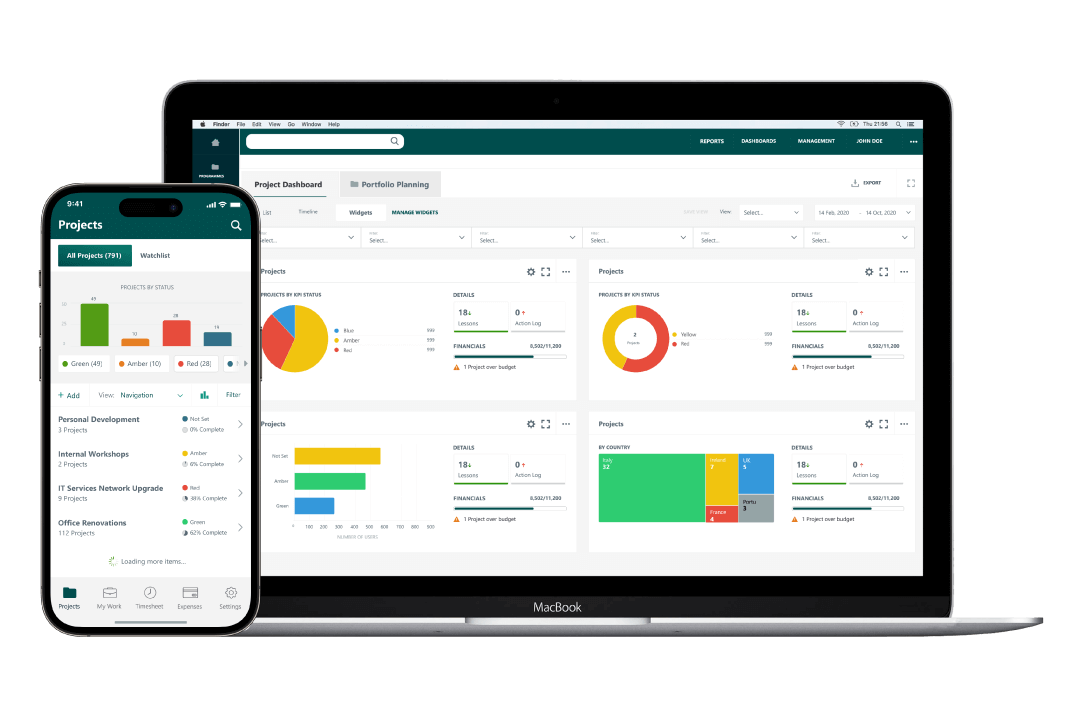
Live dashboards give snapshots of individual projects or the entire portfolio, showing at a glance how work is trending against milestones. The right PPM solution flags potential roadblocks early, so teams can act before a small issue turns into a big one.
Automated Reporting Saves PMO Teams Hours Every Month
Manual month-end reporting wastes hours hunting down information or reconciling documents with conflicting numbers, and by the time it is compiled, it is already outdated.
A real-time PPM platform keeps information current at all times, cutting report creation from weeks to minutes.
Capacity Planning Software Strengthens Visibility and Governance
Strategic capacity planning built on the right project management software tightens governance and widens visibility for everyone involved. It creates the audit trail needed for expenditures and tracks every aspect of a project.
Capacity and Resource Management Stays an Ongoing Process, Not a One-Time Plan
Strategic capacity management is not a document to file away. Capacity planning is an ongoing process that takes balance and expertise to manage well.
Companies can no longer plan annually or revisit plans only quarterly or during a crisis. The most effective organizations treat capacity planning and project portfolio planning as a continuous process, which surfaces hurdles before they turn into big problems.
A modern portfolio management solution, sharpened by AI-driven risk sensing, gives PMOs the tools to balance capacity against demand and stay positioned for success.
Static capacity plans age quickly once a portfolio changes size, adds a new region, or shifts strategic priority. Building capacity planning into the regular portfolio review cadence, rather than treating it as a separate exercise, keeps resource decisions matched to what the business actually needs next.
Cora Systems Helps PMOs Turn Capacity Data Into Confident Decisions
How Cora Systems Can Help
Cora Systems gives PMOs a single platform for capacity planning software, resource management, and AI-driven risk intelligence, instead of stitching together spreadsheets and point tools. Everything below connects to the same portfolio data, so a change in resource demand shows up in budget, schedule, and risk views at the same time.
Workforce Planning: forecast resource demand, support demand planning, and track workforce capacity across the full project portfolio.
Financial Control: connect capacity decisions directly to budget and earned value data for risk-adjusted prioritization.
Strategic Portfolio Management: align capacity planning with enterprise strategy and value realization, the same alignment Gartner research recommends.
Manufacturing, aerospace and defense, government contracting, and engineering and construction teams rely on Cora to keep manufacturing capacity planning, resource allocation, and portfolio risk sensing inside one connected system.
See how Cora Systems can strengthen your capacity planning process. Request a demo today and allow the Cora experts to walk through your portfolio, your data, and where AI-driven capacity planning software fits your roadmap.