


Choosing the wrong resource management tool costs more than money. It costs months of portfolio visibility, misallocated talent, and executive confidence in the PMO. For enterprise PMO leaders running multi-program portfolios across regulated or capital-intensive industries, the decision carries real operational weight.
This guide cuts through vendor marketing to give you a practical evaluation framework, one built around the decisions you actually make every week.
Key takeaways
Enterprise PMOs need resource management software that handles portfolio-level capacity planning, not just project-level task tracking.
Earned value management (EVM) integration is a non-negotiable requirement for organizations operating in Aerospace & Defense, the Federal Government, or capital projects.
Configurable workflows matter more than feature volume. Software that mirrors your governance model will get used. Software that fights it will get abandoned.
Vendor stability, implementation support, and data migration capability separate enterprise-grade platforms from scaled-up SMB tools.
The right platform connects resource demand to strategic decisions, giving PMO leaders a live view of capacity against the portfolio roadmap.
Why enterprise resource management software fails PMOs
Most PMOs do not fail because they lack data. They fail because their tools fragment it. Schedules live in one system, resource plans in another, financial forecasts in a third. PMO leaders spend more time reconciling spreadsheets than analyzing risk.
The core problem is that many platforms labeled "enterprise project management" were designed for smaller, less complex environments and scaled up. They handle task lists and Gantt charts well. They do not handle multi-program resource pools, regulatory reporting requirements, or portfolio-level scenario planning.
Before evaluating any platform, it is worth clarifying what your PMO actually needs: project-execution tracking or portfolio-level resource intelligence.
What enterprise project management software must do differently
Enterprise PMOs manage resources across programs, not just projects. That distinction shapes every requirement.
At portfolio scale, resource management means forecasting demand across dozens or hundreds of active projects, matching that demand against available capacity, and surfacing conflicts before they become schedule failures. It means modeling scenarios when headcount changes or priorities shift.
At the same time, enterprise project management software needs to connect resource data to financial tracking. Labor costs are project costs. If your software separates the two, your PMO is flying partially blind on budget performance.
How to evaluate PMO resource management software
PMO resource management starts with capacity visibility
The first test of any platform is simple: can you see who is available, at what percentage, across all active projects, in real time?
Weak platforms show you allocations at a point in time. Strong platforms show you forward-looking capacity curves so you can plan before the gap appears. Ask vendors specifically how their system handles resource conflicts when two projects claim the same person at the same time, and how those conflicts surface to the portfolio manager.
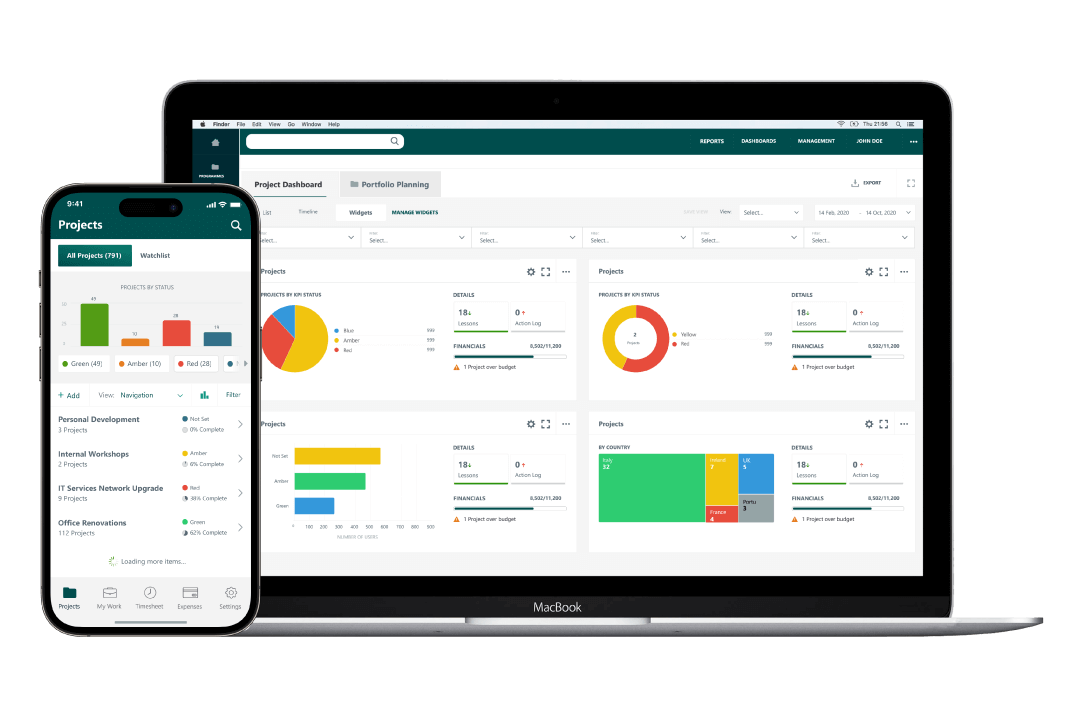
Cora Systems' resource management capability is built for this multi-program reality, giving PMO leaders a consolidated view of demand versus capacity across the entire portfolio.
Earned value management separates compliance-grade tools from the rest
For PMOs in Aerospace & Defense, the Federal Government, or major capital programs, earned value management is not a nice-to-have. It is a contractual and regulatory requirement.
EVM requires software to integrate schedule, cost, and scope baselines into a single system. Any platform that treats EVM as an add-on module or a reporting layer bolted onto project data will create audit exposure and reconciliation overhead.
When evaluating platforms, ask vendors to walk you through a live EVMS report generation workflow. See whether it pulls data from the native project and financial data or requires manual data entry. The answer tells you whether EVM is core to the architecture or an afterthought.
Complex industry software needs configurable governance, not rigid templates.
Regulated industries run governance processes that generic project tools cannot accommodate out of the box. Stage gate reviews, investment approval workflows, portfolio scoring models, and executive reporting cadences all need to be configured, not worked around.
The best complex industry software lets your PMO define the workflow logic rather than forcing your organization to conform to the vendor's assumptions about how projects should be run.
Ask vendors to show you how they have handled a governance configuration for a customer in your sector. Aerospace & Defense PMOs, government contractors, and large capital project organizations have specific requirements around program baselines, change control, and audit trails that generic configuration options often cannot meet.
Data migration and integration capability
Ask vendors for a clear integration architecture diagram and reference customers who have completed a data migration from a comparable legacy system. Implementation risk is one of the top reasons enterprise software projects fail. A platform with a shallow implementation track record in your industry is a higher-risk choice regardless of its feature set.
Cora Systems has delivered implementations across regulated industries including Aerospace & Defense, Government, and energy-sector capital projects. That depth of delivery experience matters when your program data is too complex to handle with a generic onboarding playbook.
Reporting for executive stakeholders
PMO leaders are accountable both upward and downward. The software you choose needs to produce portfolio dashboards and executive reports that your CEO, COO, and CFO can read without needing a training session.
The best platforms let you configure reporting views by role, so a program manager sees task-level detail while a transformation leader sees strategic KPIs against the portfolio roadmap. This single-source reporting model eliminates the shadow reporting that quietly undermines PMO credibility in most large organizations.
What separates US-based project management companies in this category
The vendor landscape for PMO resource management has a meaningful geography problem. Several platforms are European in origin, with US operations bolted on. That creates real differences in how they approach government contracting requirements, EVMS compliance standards set by IPMDAR and EIA-748, and integration with US-based enterprise systems.
When your PMO supports US Federal Government programs or US-based capital projects, the vendor's prior experience with US regulatory frameworks is a practical requirement, not a preference. US-based project management companies that have delivered EVMS-compliant implementations for US defense contractors or federal agencies bring a different level of readiness than vendors entering the market from outside the US.
How Cora Systems can help
Cora Systems is a Strategic Portfolio Management platform built for enterprise PMOs managing highly complex, regulatory-sensitive programs.
The platform gives PMO leaders a single system for resource capacity planning, schedule performance, earned value management, and portfolio-level reporting. Governance workflows are configurable to match your organization's stage gate and investment approval processes, rather than forcing you to adapt your model to the software.
Cora has delivered implementations across Aerospace & Defense, Government, manufacturing, and energy sectors.
Request a demo
If your PMO is running complex programs across multiple projects and you need resource management software built for that scale, Cora Systems is worth a serious look.
Request a demo to see how Cora handles capacity planning, earned value management, and portfolio reporting in a live environment configured for your industry. Bring your hardest governance scenario. That is where the difference between platforms becomes clear.